Eight illegal miners died in Chingola. Six were from the same family. Their deaths expose a bigger problem in Zambia’s mining sector: the deadly gap between controlled operations and mining that runs without safeguards.
On the mining site, some words are all-powerful. Sometimes they come from a supervisor. Sometimes from the newest person on shift. Either way, everything stops.
Safe production.
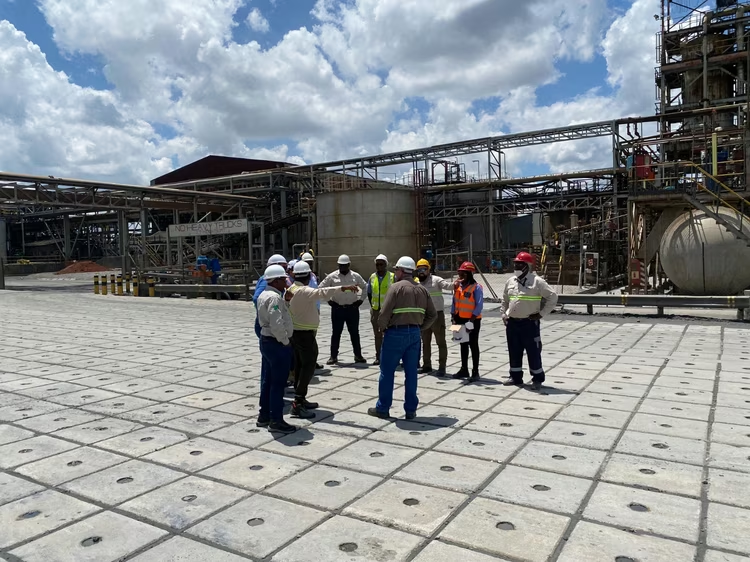
At large-scale mining operations in Zambia, mornings typically begin with a routine so repetitive it can feel boring to outsiders: a short pre-start brief, a review of hazards, a reminder that anyone can halt a task and make it safe before continuing if something looks wrong or anyone feels unsafe. No speeches. Just a firm belief that “no job is so important that it cannot be done safely”.
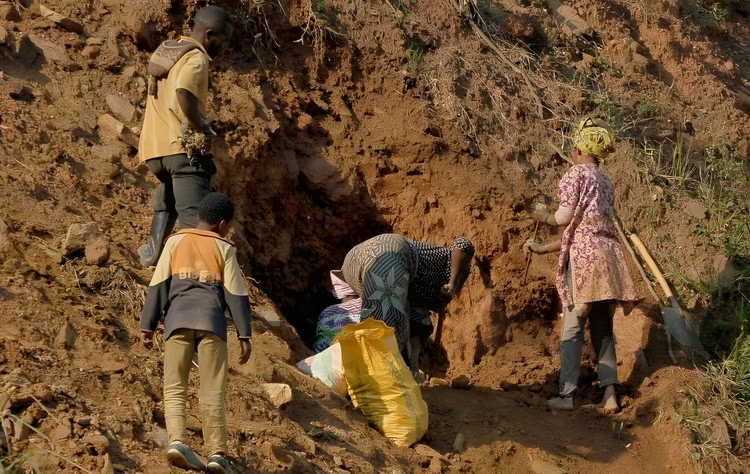
This rigidity may be the expected norm in any mine operation, until you step outside controlled sites and into informal mines where mining still happens, but without the barriers that make its dangers survivable.
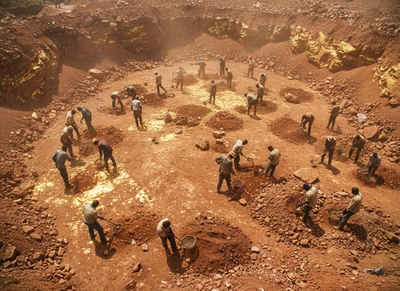
In late October 2024, eight illegal miners were buried when the earth collapsed at a dump site in Chingola. Six were from the same family. This tragedy could have been prevented with basic controls: during the rainy season, the soil softens and loses its structure. In a controlled operation, that would mean stronger ground support, restricted access, or a halt to activity. With this kind of knowledge and structure in place, those lives could have been saved.
This incident is one of several illustrating a grim picture of Zambia’s national mining safety. In a public statement, the Ministry of Mines and Minerals Development reported 88 reportable mining accidents in 2025, down from 92 in 2024, while fatalities rose from 12 to 20. The statement attributed the increase to illegal mining activities, particularly in the rainy season within the artisanal and small-scale mining sub-sector.
The numbers may seem minuscule at first glance, but they are not. Twenty fatalities is not a statistic you skim past; it is a measure of how quickly a workplace incident can become a life altered beyond recovery.
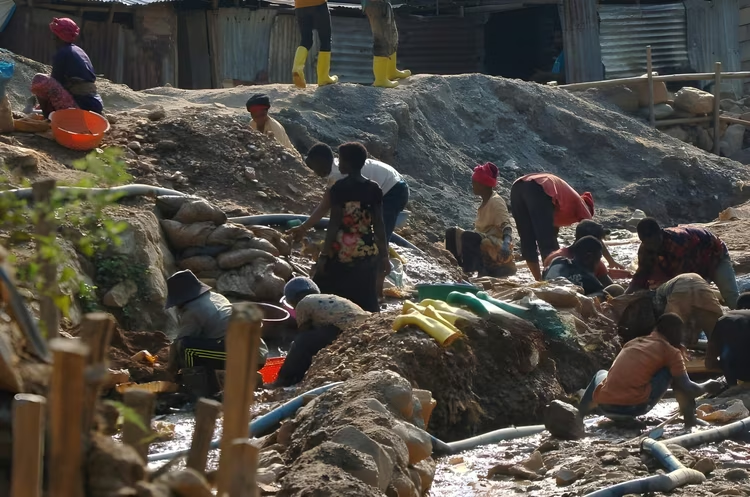
It is tempting to file illegal mining under ‘law enforcement’. But the danger is not just the lack of licences, it is structural. Illegal operations are defined by what they lack: designed ground support, trained supervision, enforced exclusion zones, emergency response readiness, and the authority to stop when something feels wrong. The reality is, when stopping the job means losing the day’s income, people keep going.
At Kansanshi, operated by First Quantum Minerals, ‘safe production’ is not a slogan. It is a strictly enforced routine. Everything stops, the conditions are inspected, the equipment waits, and someone checks the risk again. Then a competent supervisor with the means to put critical controls in place signs off, and the job continues, or doesn’t. The point isn’t all speed and production. Whether it is a quiet Tuesday or a pressured Friday, the point is safety first. Then everything follows.
Despite an otherwise grim picture, mining risk is not unique to Zambia. Even in jurisdictions with mature regulations and reforms, it is still a high-risk industry. Mining risk is not unique to Zambia. South Africa recorded 41 fatalities in 2025, down from 42 in 2024. Across ICMM member companies globally, 42 deaths were reported in 2024, up from 36 in 2023 and 33 in 2022.
The question is not how to eliminate mining risks; they are part of the job. The real question is how hazards can be prevented before they become injuries, and what should change when they nearly cause a fatality?
In Zambia, the safety debate only comes into play when there is a fatality, because it is obvious that lives have been lost. But what about non-fatal injuries that create a life-long burden? Like a crushed hand that prevents hands-on labour? Or a spinal injury that could be the centre of a family’s finances for decades? These non-fatal injuries come with a hefty price tag: loss of income, rising medical costs, to mention a few. An ‘accident’ becomes a disability, and in some cases, the disability becomes poverty.
This is where ‘responsible mining’ comes in. Just like safety, it is not a slogan but a strict set of steps taken to reduce the likelihood of harm. A near-miss on a mining site is not supposed to be a moment of relief, a ‘Whew, that was close’ moment and then back to business. Near-misses are a warning light. In disciplined operations, a near-miss triggers investigation, root-cause analysis, corrective actions, and verification that the fix will actually change the way work is done.
At Kansanshi, you will see it without even realising it: a haul truck is rerouted due to visibility, or a lifting plan is put on hold and re-checked because the initial plan doesn’t match the ground conditions. Moments such as this may not make the headlines, but that doesn’t mean they are not effective. Safety that works is often boring, but that is because the drama has been prevented.
Illegal mining is the opposite. Risk is managed by instinct, desperation, and hope. There is no consistent barrier between the hazard and the human body, and there is no paper trail that enforces change before or when things go wrong.
This is why the national conversation about illegal mining is critical. Law enforcement is important, but enforcement alone cannot be the whole strategy, because the incentives behind illegal mining are economic. If Zambia wants fewer incidents like Chingola, it needs tighter enforcement alongside pathways that pull people into legal, monitored small-scale mining, stronger inspection capacity, and real consequences for repeat negligence. And it also needs credible benchmarks inside the formal sector: operations that prove what ‘system mining’ looks like in Zambia, not just in theory.
Mining will always harbour dangers and risks. The choice is whether that danger is managed by systems or by hope.
And hope is not a control. Safety is.